Investment Philosophy
Our Philosophy
Our philosophy is to help you achieve the financial outcomes that matter most to you, without needing to become an investment expert yourself. We take the time to understand your lifestyle goals, then put in place the plans and structures designed to support them – while helping protect the financial wellbeing of the people you care about, now and into the future.
Together, we will develop and implement a financial strategy that is tailored to your needs today and flexible enough to adapt as those needs change over time.
We have a consistent record of helping clients achieve their financial goals, and we believe this is underpinned by three core components:
- Trust – The trust our clients place in us is essential to building a strong, long-term relationship.
- Strategy – Designing a strategy that is tailored to your needs is one of our core strengths and a key way we add value to your financial position.
- Performance – Delivering outcomes that meet your expectations is critical to your success and to the strength of our ongoing partnership.
Why we have an Investment Philosophy
At Vela Wealth Management, our focus is on helping clients achieve the financial outcomes that matter most to them. Our role is to guide you with clarity and confidence throughout your financial journey.
To support this, we apply a clear set of investment principles that guide portfolio decisions with consistency, discipline, and a long-term focus—helping ensure your investments remain aligned to your objectives as your needs evolve over time.
Our Investment Values
Diversification
Is the Risk Shield
By spreading portfolios across assets, geographies and styles, risk is reduced and resilience is improved through changing market conditions.
Costs matter
Outcomes matter more
Every investment decision is assessed on its after fee and after-tax contribution to long term client outcomes.
Asset allocation
Drives the result
The right mix of growth and defensive assets helps align portfolios to client goals, risk tolerance, income needs and time horizon.
Active where it adds value
Passive where it doesn’t
Passive investments form the core, with active management used selectively, where there is strong conviction, it can add value after costs.
Risk Management
And returns go hand in hand
Managing downside risk, sequencing risk and behavioural stress helps clients stay disciplined and better positioned to achieve their goals.
Investment principles in action
Diversification is key.
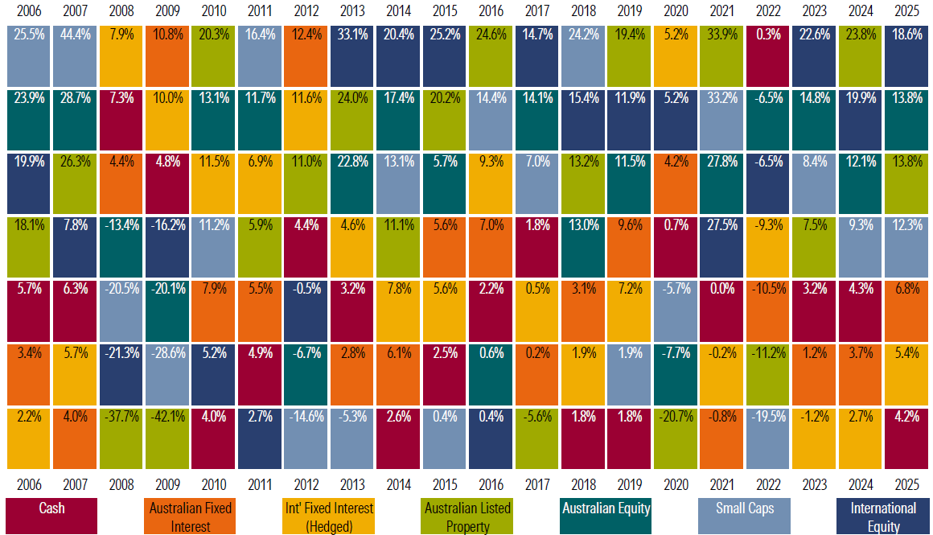
It’s unlikely anyone can pick the asset class winner, in any given year.
This chart shows the annual performance of major asset classes over time, highlighting the variability of returns from year to year. Each column represents a calendar year, with coloured boxes showing the return for each asset class. Asset classes including cash, fixed interest, listed property, Australian equities, small caps and international equities have all experienced periods of strong and weak performance.
The key takeaway is that returns are inconsistent across asset classes in any given year, reinforcing the importance of diversification and a disciplined long-term investment approach rather than trying to predict short-term winners.
Annual Asset Class Returns – Calendar Year

Chasing Last Year’s Winner
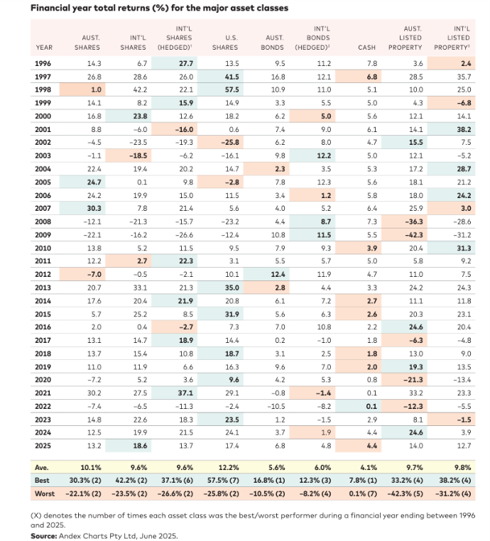
We all have the tendency to focus on short term returns. However, basing your investment strategy on last year’s best performing asset class is a flawed approach to investing.
The table highlights (in green) the best performing asset class for each financial year from 2011 to 2025. Basing your investment on last year’s winning asset class will not guarantee future success. This is clearly shown by the return Australian Listed Property generated in the year of 2021 (33.9%) compared to 2022 (-11.2%).
As shorter-term market directions are difficult to predict, it is a more sensible strategy to have diversified exposure to a range of asset classes, rather than trying to pick the best performer in each given quarter or year.
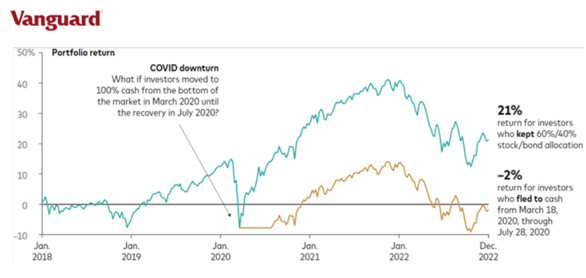
Emotional investing can be costly.
This chart clearly shows how emotional investing—especially during market downturns—can significantly impact long-term returns.
During the COVID market shock in March 2020, investors who stayed invested in a balanced 60/40 equity/bond portfolio saw a 21% return by December 2022. In contrast, those who moved to cash during the panic only earned -2% over the same period.
This 23% gap underscores the cost of reacting emotionally to short-term volatility. A quality adviser plays a crucial role in helping investors navigate uncertainty, stay focused on their long-term goals, and avoid decisions that may feel safe in the moment but prove costly over time.